



Jurij Lotman
Semiotics of Cinema.
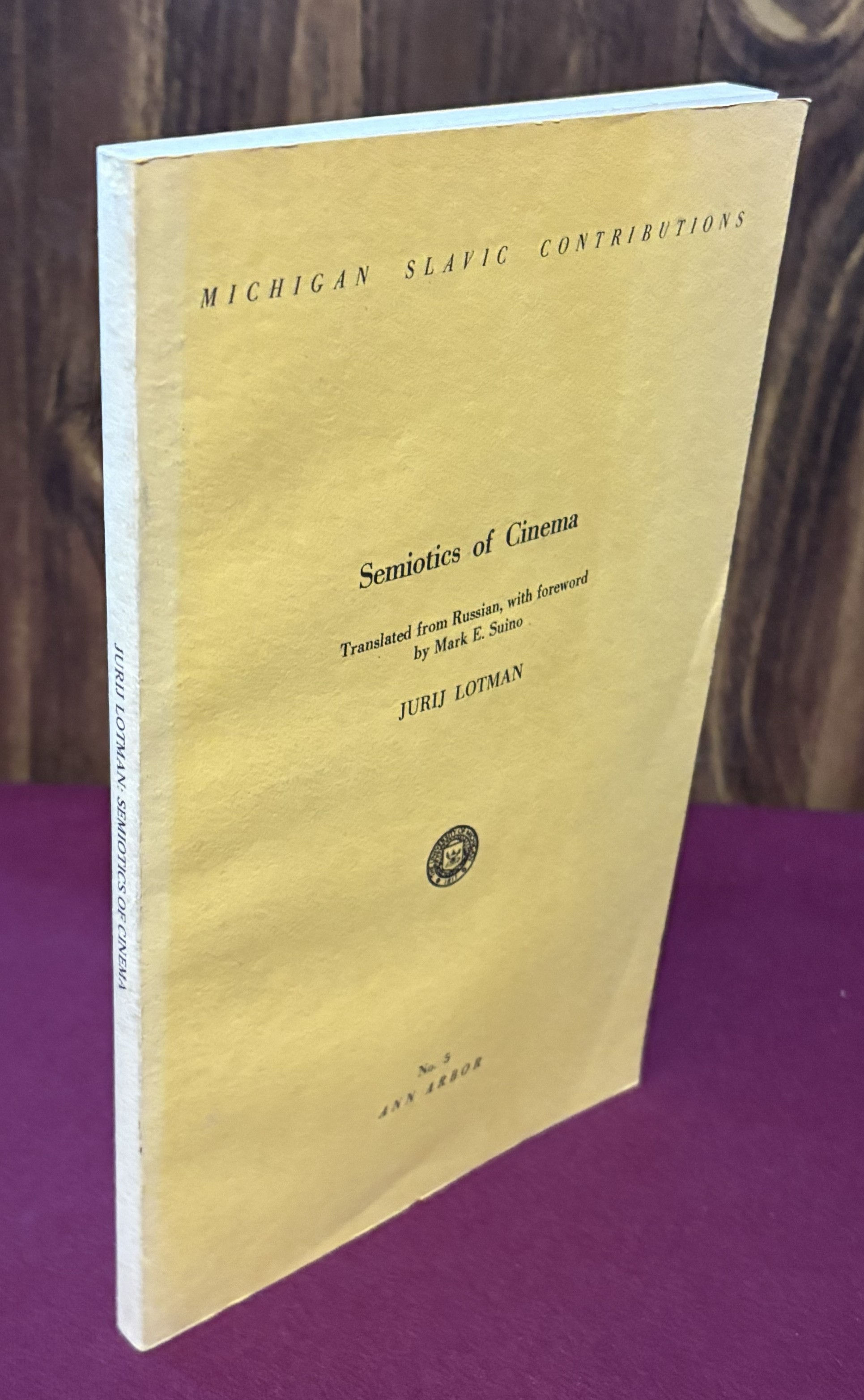
Department. of Slavic Languages and Literature, University of Michigan, 1981. Michigan Slavic Contributions, No. 5. Translation by Mark E. Suino of “Semiotika kino i problemy kinoestetiki” (Eesti raamat, 1973). 106 pages.
Softcover volume, measuring approximately 5.5” x 8.5”, displays very light shelfwear. Binding is sound. Pages are clean and bright.
“In “Semiotics of Cinema” Jurij Lotman discusses the general theory of signs in art, and demonstrates the manner in which cinema produces its own sign system.
Further, he treats the problems of aesthetics in cinema, pointing out the nature of film language and the way in which it is to be apprehended.
A special difficulty facing cinematic art is the fact that, unlike, for example, classical music or abstract painting, the film audience is quite vast and, for the most part, ignorant of the very existence of cinematic language. The same may be said of other art forms, but it is true to a lesser degree and involves a much smaller population.
Another difficulty (at least where sound films are concerned) is that natural language and visual images are employed. In ordinary life we are not accustomed to treating either as a secondary modeling system, but as elements of reality. It is extraordinary difficult for a mass audience to become accustomed to the use of familiar aspects of reality on a more abstract level of modeling.
“Semiotics of Cinema” advances an area of investigation of cinema which was begun, in Russia, by the Formalists (Shklovskii, Tynaynov) and continued by, among others, Mukaiovsky in Czechoslovakia is still an important subject for contemporaries such as V. V. Ivanov in the Soviet Union and Roman Jakobson in the United States. At the present time the semiotics of cinema has attracted the attention of scholars in many parts of Europe and the United States, and Lotman’s book attempts to provide alternatives to, for example, the positions of Cahiers du cinema and Siegfried Kracauer.”
